Famous Street Food in India: A Delicious Journey Through Every State
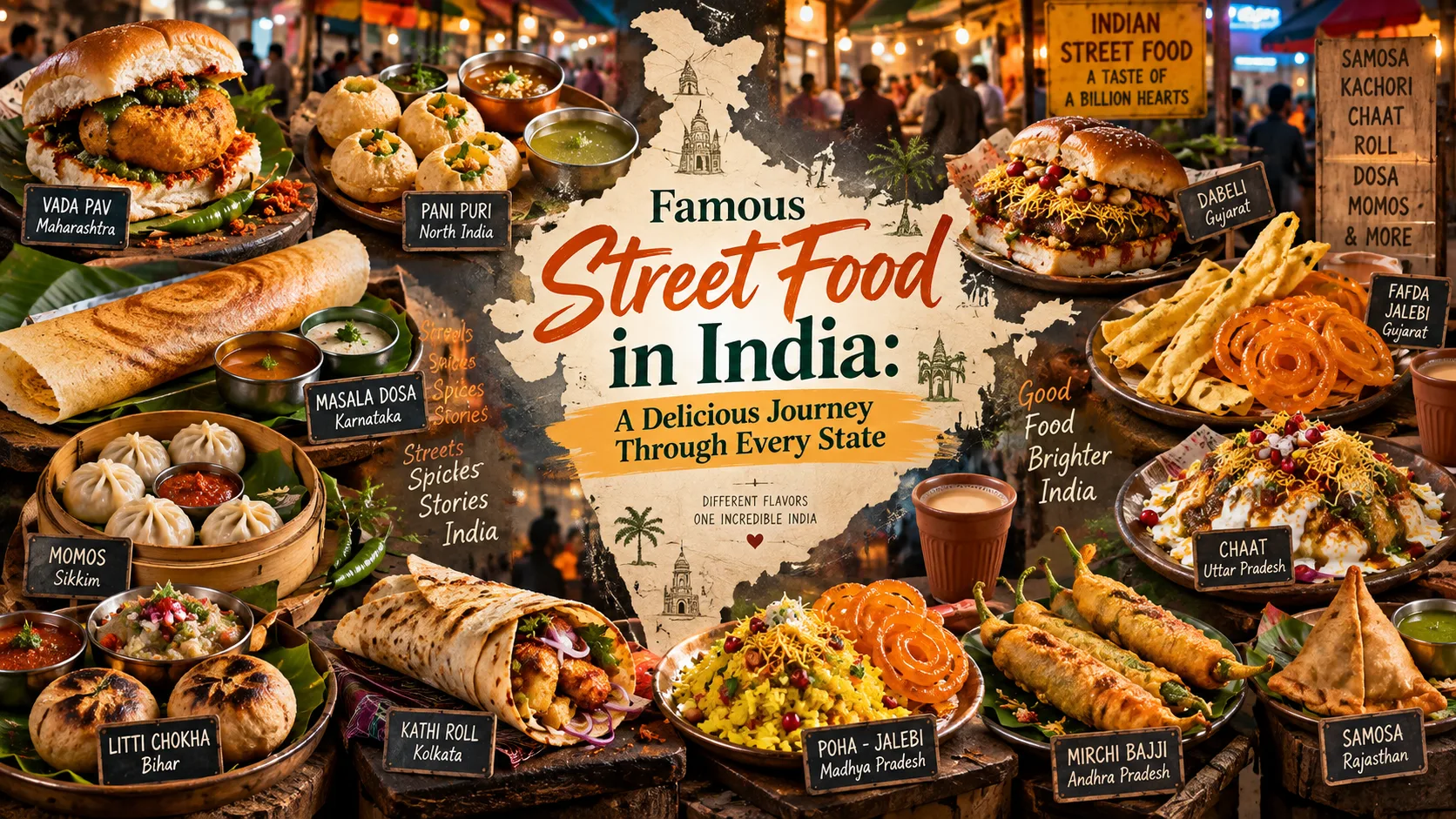
1. Andhra Pradesh – Punugulu and Mirchi Bajji
If you're wandering through an Andhra Pradesh market in the evening, there's a good chance you'll come across a stall frying batches of punugulu.
These little fritters are usually made from fermented idli or dosa batter, sometimes mixed with chopped onions, green chillies, cumin and coriander. They're fried until the outside turns crisp, while the centre stays soft.
Punugulu are best eaten straight from the kadai, with coconut or peanut chutney on the side.
Another snack worth trying is mirchi bajji. Large green chillies are coated in gram-flour batter and deep-fried. Depending on the stall, the chillies might be stuffed with a tangy mixture or served chopped up with onions, masala and a squeeze of lemon.
Andhra Pradesh is also known for pesarattu, garelu and onion pakodi, so there's plenty to explore if you enjoy savoury snacks.
2. Arunachal Pradesh – Momos and Thukpa
When the weather turns cold in Arunachal Pradesh, a plate of steaming momos is an inviting sight.
Momos are dumplings made with thin dough and filled with vegetables or meat. They're generally steamed and served with a spicy red chilli chutney that adds a good amount of heat.
They're simple, filling and easy to find in many local markets.
Thukpa is another dish you'll come across in the region. This comforting noodle soup usually contains vegetables, noodles and sometimes meat.
Unlike dishes that rely on heavy spice mixtures, thukpa draws much of its flavour from the broth and the ingredients cooked in it.
A hot bowl is especially welcome after spending time outdoors in the mountain weather.
3. Assam – Pitha and Ghugni
Rice is central to Assamese cooking, and pitha is one of the best ways to experience that tradition.
Pitha isn't a single snack. It's a whole family of preparations, with different varieties made for different occasions.
Til pitha, for example, combines rice with a filling of sesame seeds and jaggery. Ghila pitha is a fried variety with a richer texture.
These foods are particularly associated with Bihu celebrations, although they're enjoyed beyond the festival season too.
If you're looking for something savoury, ghugni is worth trying. Made with peas or chickpeas cooked in spices, it's a warm, filling snack that works especially well on cooler days.
Together, pitha and ghugni offer a glimpse of Assam's traditional ingredients and everyday food habits.
4. Bihar – Litti Chokha
Litti chokha is one of those dishes that doesn't need an elaborate presentation to make an impression.
Litti consists of round wheat dough balls stuffed with sattu, or roasted gram flour, mixed with spices and seasonings. Traditionally, they're roasted until the outside develops a firm, slightly smoky crust.
The litti is served with chokha, a mashed preparation made from ingredients such as roasted brinjal, potato and tomato.
And, of course, there's ghee.
Freshly roasted litti with a little ghee poured over it is a combination of smoky, earthy and rich flavours. The chokha adds moisture and a pleasant contrast.
It's rustic, substantial food that has become closely associated with Bihar.
While exploring the state's local food, keep an eye out for sattu sharbat, thekua and khaja as well.
5. Chhattisgarh – Chila and Faraa
Not every Indian snack needs to be deep-fried, and Chhattisgarh has some lovely examples of simpler preparations.
Chila is a savoury pancake that can be made using rice-based batter. Cooked on a hot tava, it's soft, light and satisfying without being particularly heavy.
Faraa is another traditional preparation made from rice flour.
These steamed dumplings have a soft texture and are generally seasoned without overwhelming the natural flavour of the rice.
Both dishes reflect the importance of rice in the region's food culture.
They're also good choices if you're looking for something different from the usual samosas, pakoras and other fried street snacks.
6. Goa – Ros Omelette and Cutlet Pao
There's much more to eating in Goa than seafood restaurants and beach cafés.
Step into a local market or visit an evening food stall, and you'll find quick meals that are popular with locals.
Ros omelette is one of them.
A freshly cooked omelette is covered with a hot, flavourful gravy known as ros and served with Goan bread. The gravy can vary considerably from one stall to another, which means the dish doesn't taste exactly the same everywhere.
Cutlet pao is another popular option.
A crisp cutlet is tucked into soft local bread and finished with accompaniments such as chutney, onions or salad.
Both dishes make filling snacks, particularly when you want something quick rather than a sit-down meal.
7. Gujarat – Dabeli, Fafda-Jalebi and Locho
Gujarat has an incredible variety of vegetarian snacks, and many of them combine sweet, spicy and tangy flavours in the same dish.
Dabeli is a perfect example.
Originally associated with Kutch, it consists of a soft pav filled with spiced potato, chutneys, peanuts, sev and often pomegranate.
The soft bread, crunchy peanuts and sweet-spicy filling make it especially satisfying. It's the kind of snack where every bite offers a slightly different combination of flavours.
Then there's fafda-jalebi, a classic Gujarati pairing.
Fafda is crisp and savoury, while jalebi is sweet and soaked in syrup. They're commonly served together, often accompanied by fried green chillies and papaya sambharo.
Surat has its own speciality: locho.
This soft, savoury snack is typically served with masala, oil, coriander, sev and chutneys. Its texture is quite different from the crisp snacks you might normally associate with Gujarati food.
Other local favourites include khaman, khichu, sev khamani and patra.
If you enjoy vegetarian street food, Gujarat offers more variety than you could comfortably cover in a single day.
8. Haryana – Chole Samosa, Kachori and Lassi
Haryana's food is known for its hearty character, and dairy products play a prominent role in the state's culinary traditions.
At local snack stalls, chole samosa is a popular choice.
A freshly fried samosa is broken open and topped with spiced chickpeas, chutneys, onions and masala. The result is a satisfying combination of crispy pastry and warm, flavourful chole.
Kachori is another familiar snack you'll find in markets.
And if you're in the mood for something refreshing, order a glass of lassi.
Haryanvi lassi is often thick, rich and served chilled. It's particularly enjoyable during the hot summer months, although a generous serving can be filling enough at any time of year.
9. Himachal Pradesh – Siddu and Babru
Himachal Pradesh's traditional food makes good use of ingredients and cooking methods suited to the mountain climate.
Siddu is a good example. This steamed bread, sometimes prepared with a savoury filling, is typically served hot with ghee. It's soft, substantial and especially enjoyable when the weather is cold.
Babru is another regional favourite.
At first glance, it might remind you of a puri or kachori, but this fried bread has its own distinct preparation and flavour.
Both dishes are worth looking for if you want to explore Himachali food beyond the more familiar roadside noodles and momos.
10. Jharkhand – Dhuska and Ghugni
Dhuska is a traditional Jharkhand snack that deserves a place on any regional food list.
It's prepared from a mixture of rice and lentils, which is fried until golden. The outside develops a light crispness, while the inside remains soft.
Dhuska is commonly served with ghugni, a warmly spiced preparation of peas or chickpeas.
The two work particularly well together. Pieces of dhuska soak up the curry, giving each bite a combination of textures and flavours.
It's a simple, filling meal and a good introduction to Jharkhand's traditional cooking.
11. Karnataka – Masala Dosa, Maddur Vada and Churmuri
It's difficult to talk about Karnataka's food without mentioning masala dosa.
A well-made dosa has a thin, crisp exterior wrapped around a mildly spiced potato filling. Served with coconut chutney and sambar, it's a satisfying breakfast or snack.
But Karnataka has plenty more to offer.
Maddur vada, named after the town of Maddur, is a popular fried snack. Unlike the familiar ring-shaped medu vada, it's relatively flat and is made using ingredients such as rice flour, semolina, onions and curry leaves.
For something lighter, there's churmuri.
This puffed-rice snack is mixed with chopped vegetables, spices and other seasonings just before serving. It has a lovely crunch and is particularly enjoyable when freshly prepared.
From crisp dosas to quick puffed-rice snacks, Karnataka offers a wide range of flavours and textures.
12. Kerala – Pazham Pori, Parippu Vada and Thattu Dosa
Rainy evenings and hot snacks are a familiar combination in Kerala.
Pazham pori, or banana fritters, is a popular tea-time treat. Slices of ripe banana are dipped in batter and fried until golden.
The batter becomes lightly crisp, while the banana inside turns soft and sweet.
If you prefer something savoury, try parippu vada.
Made from coarsely ground lentils, onions, green chillies and curry leaves, these fritters are crisp on the outside and packed with flavour.
Kerala's roadside thattu kada stalls also serve small dosas, commonly known as thattu dosa, with chutneys and curries.
Whether you're stopping for a quick breakfast or an evening snack, these traditional dishes are well worth trying.
13. Madhya Pradesh – Poha-Jalebi, Bhutte Ka Kees and Garadu
If there's one city that comes up repeatedly in conversations about Madhya Pradesh's street food, it's Indore.
And one of the best-known local combinations is poha-jalebi.
Indori poha is light, soft and typically topped with sev, coriander, lemon and a blend of seasonings. Some vendors add chopped onions as well.
It's often eaten alongside hot jalebi, whose syrupy sweetness contrasts with the savoury poha.
Another Indori speciality is bhutte ka kees.
Grated corn is cooked with milk and spices to create a soft, creamy dish that makes excellent use of a simple ingredient.
During winter, look for garadu.
Pieces of yam are fried and tossed with spices and lemon juice, creating a snack that's crispy, tangy and pleasantly spicy.
Indore's food culture is especially appealing if you enjoy trying several small dishes rather than settling for one large meal.
14. Maharashtra – Vada Pav, Pav Bhaji and Misal Pav
Ask someone to name a famous Mumbai street food, and vada pav will probably be among the first answers.
It's a simple idea: a spiced potato filling coated in gram-flour batter, deep-fried and placed inside a soft pav.
Chutneys complete the sandwich, with dry garlic chutney adding the distinctive flavour associated with many Mumbai-style versions.
It's affordable, easy to eat on the move and deeply connected to the city's everyday food culture.
Pav bhaji is another classic.
A mixture of vegetables is mashed and cooked on a large tava with spices and butter. The bhaji is served with toasted pav, chopped onions and lemon.
For something with a little more heat, there's misal pav.
This dish combines sprouted legumes, spicy gravy, crunchy farsan, onions, coriander and pav. Different parts of Maharashtra have their own versions, so the flavour and spice level can change depending on where you eat it.
Together, these dishes show why Maharashtra's street food has become familiar far beyond the state.
15. Manipur – Singju and Bora
Manipur offers a different kind of street-food experience, particularly for those more familiar with the fried snacks and rich gravies of northern India.
Singju is a traditional salad-like dish prepared using finely sliced vegetables and local seasonings.
Depending on the recipe, it may include cabbage, lotus stem, papaya, seasonal greens and other ingredients.
What makes singju interesting is its freshness and the combination of textures. The vegetables retain their crunch, while the seasonings bring everything together.
Bora, a type of fritter, is another snack to look for.
Served alongside or enjoyed separately, these crispy fritters offer a pleasant contrast to the fresh ingredients in singju.
Both dishes provide a good starting point for exploring Manipuri food traditions.
16. Meghalaya – Jadoh and Pukhlein
Meghalaya's food culture reflects its local ingredients and the culinary traditions of its communities.
Jadoh is a well-known Khasi rice dish, traditionally associated with meat and local seasonings.
It's a substantial preparation and an important part of the region's food culture, although it's not exclusively a street snack.
For something sweet, look for pukhlein.
This fried snack is made using rice and jaggery or another sweetener. It has a rich flavour and a golden exterior.
A piece of pukhlein with a cup of hot tea is a lovely combination, particularly in Meghalaya's cooler weather.
These dishes are worth exploring if you want to discover foods that aren't commonly found on mainstream Indian street-food menus.
17. Mizoram – Chhangban and Bai
Mizo cuisine often uses simpler seasoning and less oil than the rich, heavily spiced dishes many travellers associate with Indian food.
Chhangban is a traditional sticky rice preparation enjoyed as a snack.
Its appeal lies in the texture of the rice and the simplicity of the preparation.
Bai, meanwhile, is a traditional dish made with vegetables, local greens and ingredients such as bamboo shoots. Some versions also include meat.
Rather than covering everything in a thick masala, these preparations allow the individual ingredients to retain much of their natural flavour.
Chhangban and bai offer a glimpse of Mizoram's distinct food traditions and the importance of locally available ingredients.
18. Nagaland – Pork Momos and Smoked Pork
Nagaland has a food culture shaped by ingredients such as bamboo shoots, fermented soybeans, smoked meat and intensely hot chillies.
In towns such as Dimapur, pork momos are among the snacks you may come across.
These steamed dumplings are filled with pork and often served with a hot chilli-based sauce.
Smoked pork is another important part of Naga cuisine.
It may be cooked with bamboo shoots, fermented ingredients or local chillies, producing flavours that are quite different from the familiar onion-and-tomato-based gravies found elsewhere in India.
If you're interested in understanding Nagaland's regional food, dishes prepared with smoked and fermented ingredients are worth exploring.
They reveal a cooking tradition that has its own methods, ingredients and character.
19. Odisha – Dahibara Aloo Dum, Bara Ghuguni and Gupchup
Odisha has some wonderful street-food combinations, and dahibara aloo dum is one of the most recognisable.
It's particularly associated with Cuttack.
Soft lentil vadas are soaked in curd and served with hot, spicy potato curry. Ghuguni, a preparation of spiced peas, is often added.
The contrast is what makes this dish interesting. You get cool, slightly sour curd, soft vadas and warm, spicy curry in the same serving.
Another popular combination is bara ghuguni.
Here, fried lentil vadas are served with a spiced pea preparation, creating a filling snack that works well at breakfast or later in the day.
And then there's gupchup.
Similar in concept to pani puri, it consists of crisp, hollow puris filled with a mixture and served with tangy flavoured water.
If you're visiting Odisha, these three dishes are a great place to begin exploring the state's street-food culture.
20. Punjab – Amritsari Kulcha, Chole and Lassi
Punjab's food is known for its generous portions and rich flavours, and Amritsari kulcha is a classic example.
This stuffed bread is cooked until parts of the surface become crisp while the inside stays soft.
It's generally served with spicy chole, along with onions, pickles or chutney.
The combination makes a substantial meal, even when eaten at a roadside stall or small eatery.
Chole itself is a much-loved preparation, with different cooks using their own spice blends and cooking techniques.
To finish, there's Punjabi lassi.
Served thick and chilled, it's a refreshing companion to a spicy meal. Sweet versions can be particularly rich, making them feel almost like a dessert.
If you enjoy hearty food, Punjab's street-side eateries have plenty to offer.
21. Rajasthan – Pyaaz Kachori and Mirchi Bada
Rajasthan's markets are full of fried snacks, and two of the most familiar are pyaaz kachori and mirchi bada.
Pyaaz kachori is especially associated with cities such as Jodhpur.
It has a flaky, crisp shell filled with a spiced onion mixture. The filling adds plenty of flavour, while the pastry provides a satisfying crunch.
It's commonly enjoyed with chutneys that bring sweetness or tanginess to the dish.
Mirchi bada is another popular snack.
A large chilli is stuffed, coated in gram-flour batter and fried until golden.
The chilli, filling and crispy coating create a combination that's especially appealing to people who enjoy spicy food.
Both are best enjoyed freshly prepared, while the outer layer is still hot and crisp.
22. Sikkim – Momos, Thukpa and Sha Phaley
Sikkim's food reflects the culinary influences of its Himalayan location, including Tibetan and Nepali traditions.
Momos are among the most familiar snacks.
They're typically steamed and filled with vegetables or meat, then served with a spicy chilli sauce.
During colder weather, thukpa becomes an appealing option. The warm broth, noodles and vegetables make it a comforting meal after a day outdoors.
Another dish to look out for is sha phaley.
This fried pastry traditionally contains a savoury filling enclosed in dough. Frying gives it a crisp exterior, while the filling remains soft and flavourful.
These dishes are closely associated with the region's food culture and are particularly enjoyable in Sikkim's cool mountain climate.
23. Tamil Nadu – Kothu Parotta, Bajji and Sundal
Kothu parotta is one of those dishes that catches your attention before it reaches your plate.
The cook places parotta on a hot tava and chops it rapidly using metal spatulas. Vegetables, spices, gravy and other ingredients are mixed into the shredded bread as it cooks.
The result is a flavourful, filling dish with a distinctive texture.
If you're looking for something lighter, try sundal.
Boiled chickpeas or other legumes are tossed with coconut, spices and seasoning. It's a simple snack that can be both satisfying and relatively light.
Bajji is another favourite across Tamil Nadu.
Banana, chilli, onion and other ingredients are coated in batter and fried until golden. These fritters are particularly enjoyable with chutney and a cup of tea.
From the lively preparation of kothu parotta to the simplicity of sundal, Tamil Nadu has plenty to offer street-food lovers.
24. Telangana – Mirchi Bajji, Lukhmi and Irani Chai
Hyderabad's food culture gives Telangana a distinctive street-food identity.
Mirchi bajji is a familiar sight at local snack stalls.
Large green chillies are coated in batter and fried, then sometimes served with chopped onions, lemon juice and masala.
Another Hyderabad speciality is lukhmi.
This crisp savoury pastry traditionally has a spiced filling and is closely associated with the city's culinary heritage.
And no introduction to Hyderabad's everyday food culture would be complete without mentioning Irani chai.
This rich tea, prepared with milk and served sweet, is commonly enjoyed alongside biscuits and bakery snacks.
Hyderabad's Irani cafés are an important part of the city's food culture, offering a place to enjoy a cup of tea, a quick snack and a break from the busy streets.
25. Tripura – Jhalmuri and Churmur
Tripura's food scene includes both Bengali-influenced snacks and the traditional ingredients of its indigenous communities.
Jhalmuri is one of the familiar snacks found in local markets.
Puffed rice is tossed with chopped vegetables, spices, mustard oil and crunchy ingredients.
It's prepared quickly, which helps the puffed rice retain its texture.
Churmur and other chaat-style snacks are also found in urban areas.
However, there's much more to Tripura's food culture than these familiar market favourites.
Traditional preparations often make use of bamboo shoots, rice, vegetables and fermented ingredients.
Exploring both the street snacks and the local dishes offers a more complete picture of the state's food traditions.
26. Uttar Pradesh – Kachori-Sabzi, Aloo Tikki and Tamatar Chaat
Uttar Pradesh has such a varied street-food culture that individual cities could easily fill an entire food guide.
Start with kachori-sabzi, a popular breakfast combination.
Freshly fried kachori is served with hot potato curry. The exact preparation and accompaniments vary from one place to another.
Lucknow is particularly well known for its chaat, including aloo tikki.
A potato patty is fried until crisp and then served with accompaniments such as chickpeas, curd, chutneys and spices.
Varanasi brings something different to the table: tamatar chaat.
Tomatoes are cooked with potatoes, spices and other ingredients to create a warm, tangy preparation that's served in a bowl.
These three dishes show how much variety exists within a single state.
Even if you've tried kachori or chaat elsewhere in India, the local versions in Uttar Pradesh are worth seeking out.
27. Uttarakhand – Bun Tikki and Aloo Ke Gutke
Uttarakhand offers an interesting mix of familiar street snacks and traditional hill cuisine.
In Dehradun, bun tikki is a popular local favourite.
A crisp potato tikki is placed inside a soft bun and finished with chutneys and other accompaniments.
It's simple, affordable and filling.
For something more closely associated with the state's hill regions, try aloo ke gutke.
This traditional potato preparation uses spices and tempering to bring flavour to the potatoes without relying on a heavy gravy.
It's straightforward cooking, but that's part of its appeal.
Both snacks are worth exploring, especially if you want to experience the difference between Uttarakhand's urban street food and its traditional regional dishes.
28. West Bengal – Puchka, Kathi Roll and Jhalmuri
Kolkata is a city where street food is an essential part of everyday life.
Puchka is among its most recognisable snacks.
Like pani puri, it consists of a crisp, hollow puri filled with a mixture and served with flavoured water. Kolkata's version is particularly known for its tangy, tamarind-forward flavour.
Then there's the kathi roll.
A paratha is wrapped around a savoury filling with onions, seasonings and sauces, creating a convenient meal that can be eaten on the go.
Vegetarian and non-vegetarian versions are both available.
Jhalmuri is another Kolkata classic.
Puffed rice is tossed with vegetables, mustard oil, chillies and crunchy ingredients. The mustard oil gives it a distinctive aroma and flavour.
During the monsoon, you might also come across telebhaja, a broad category of fried snacks commonly enjoyed with tea.
From puchka stalls to roll shops, Kolkata has a street-food culture that rewards anyone willing to explore its neighbourhood markets.